

Long before modern wellness routines existed, Ayurveda had already built an entire framework around the ear — Karna, in Sanskrit. It's treated not as an isolated organ to fix when something goes wrong, but as part of a wider system that benefits from steady, gentle care. Here's a closer look at that classical thinking, and where a formula like Ear Veda fits into it.
Ayurveda associates the ear with Vata dosha — the principle governing movement, dryness, and the nervous system. A Vata-dominant zone is considered more sensitive to cold, dryness, and irregular routine, which is part of why classical texts emphasise gentle, warming, oil-based care over harsher interventions.
Karna Purana — the practice of placing a few warm drops of herb-infused oil in the ear — appears across classical Ayurvedic texts as a routine part of Dinacharya (daily regimen), not something reserved only for discomfort. The idea is preventive, rhythmic care rather than a one-time fix.
Beyond oiling, classical Ayurveda points to a handful of everyday factors — excess exposure to cold wind, aggressive cleaning with hard objects, irregular sleep, and high stress — as things that can disturb Vata balance in this region. None of these require a product to address; they're simply habits worth being mindful of.
Classical formulations for ear wellness typically draw on a small set of trusted herbs. Garlic and Tulsi are long-standing choices, alongside Ashwagandha for its calming qualities, and Turmeric, Boswellia, and Yashtimadhu for their traditional association with comfort and soothing. Each plays a supporting role rather than acting alone — which is the broader Ayurvedic philosophy of formulation.
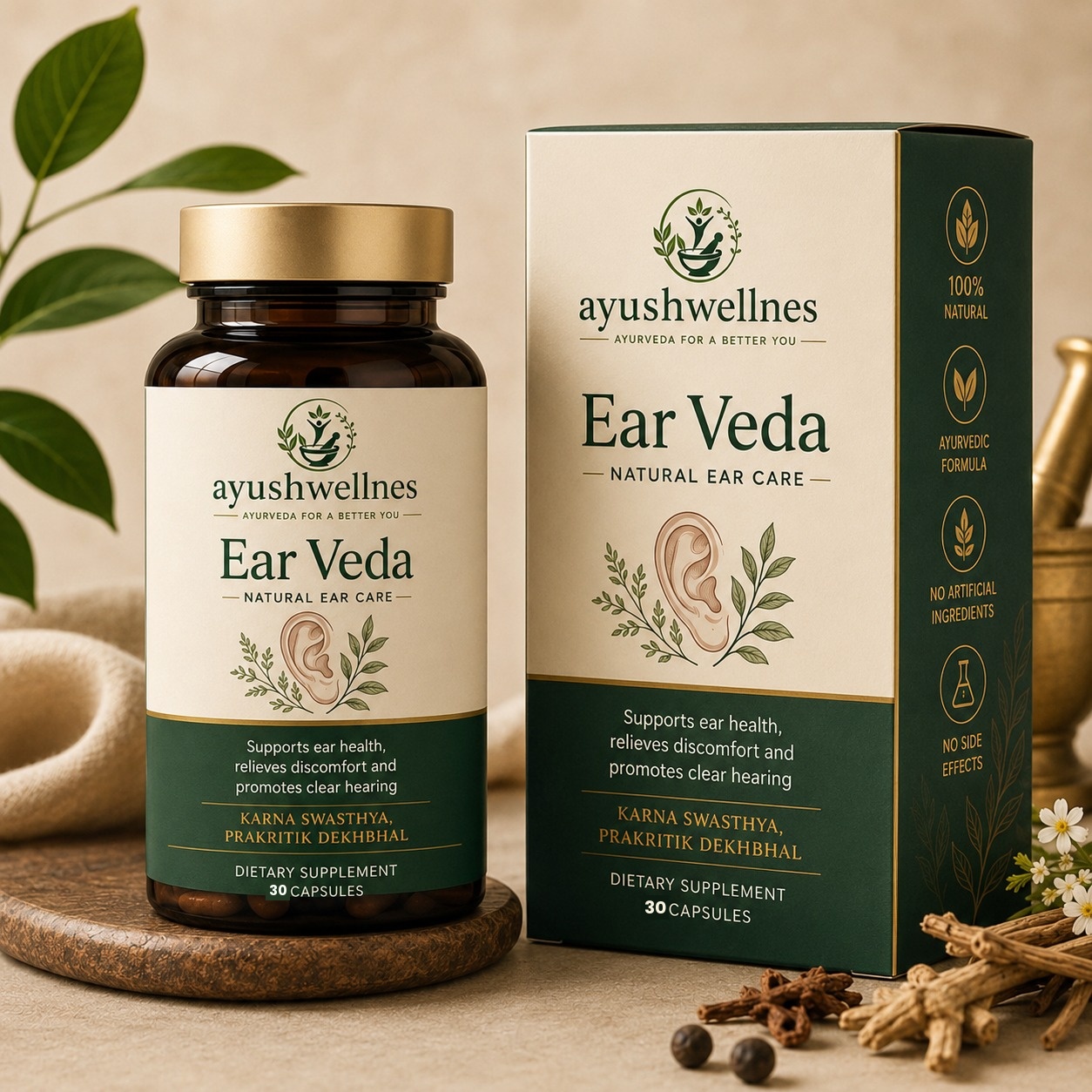
Ear Veda is built on this same principle — a blend of classical herbs meant to be taken consistently as part of a daily wellness routine, not as a one-time intervention. Like any Ayurvedic formula, it works alongside your habits, not instead of them, and it isn't a substitute for medical care if you're experiencing persistent or severe symptoms.
Is ear oiling something I need special training for?
No — classical Karna Purana is meant to be a simple, gentle home practice. A few warm drops, applied carefully, is the traditional approach. If you're ever unsure, it's worth checking with a doctor first, especially if you have any existing ear condition.
How often does Ayurveda recommend ear care?
Dinacharya generally favours regularity over intensity — a small, consistent routine is considered more valuable than occasional, heavier intervention. Consistency is really the core idea across most classical Ayurvedic practices.
Statements have not been evaluated for medical accuracy — consult a doctor before use.